

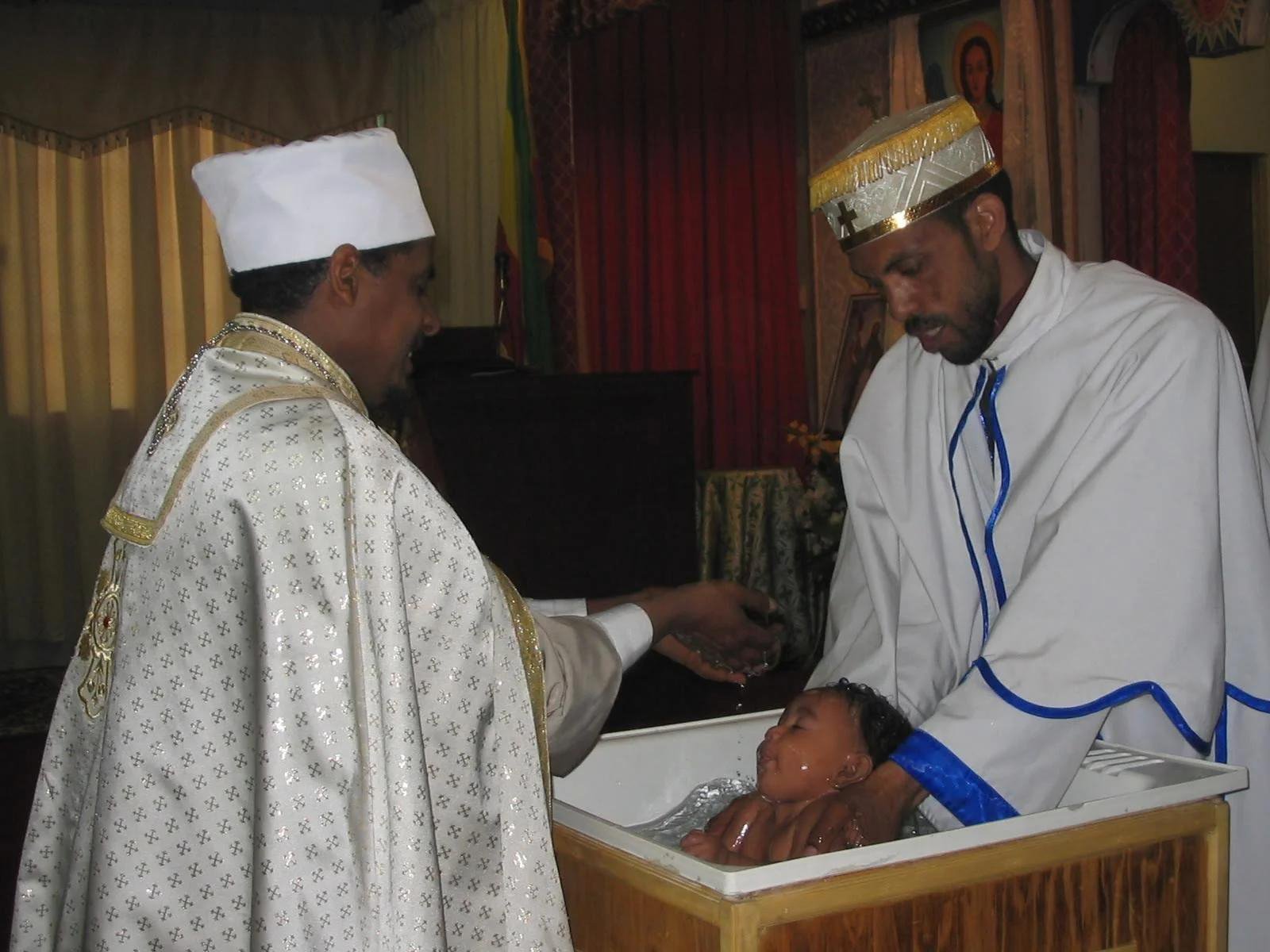
The Mystery of Holy Baptism
Holy Baptism is the first and foundational sacrament of the Ethiopian Orthodox Tewahedo Church. It is the mystery through which a person is born again of water and the Holy Spirit, becoming a member of the Body of Christ and entering into the life of salvation.
From the beginning, humanity was created in purity and holiness, but through sin, man fell and became separated from God. Because of this, Christ came into the world to restore humanity. Baptism is the means through which each person personally participates in this restoration. As our Lord said: “Unless one is born of water and the Spirit, he cannot enter the kingdom of God” (John 3:5).
Baptism is not merely a symbolic act, but a real transformation. Through it, sins are washed away, and the believer is spiritually reborn. The Apostle Paul teaches: “We were buried with Him through baptism into death, that just as Christ was raised from the dead… we also should walk in newness of life” (Romans 6:4). This shows that baptism is a participation in the death and resurrection of Christ.
In the Ethiopian Orthodox Church, baptism is performed by full immersion in water, in the name of the Father, the Son, and the Holy Spirit. This follows the command of Christ: “Go therefore and make disciples of all nations, baptizing them…” (Matthew 28:19). Through this act, the believer is united with the Holy Trinity and becomes a new creation.
Baptism also grants the forgiveness of sins. It removes both original sin and all personal sins committed before baptism. As it is written: “Repent, and let every one of you be baptized… for the remission of sins” (Acts 2:38). Through this cleansing, the person is made pure and restored to communion with God.
The Church Fathers speak strongly about the importance of baptism. Saint Cyril of Jerusalem teaches that through baptism we receive illumination and become children of God. Saint Basil the Great explains that baptism is the beginning of spiritual life and the foundation of all other sacraments. Saint John Chrysostom calls baptism a washing, a sanctification, and a new birth.
In the Ethiopian Orthodox tradition, baptism is usually administered to infants, showing that salvation is a gift of God’s grace and not dependent on human effort alone. Just as circumcision was given to infants in the Old Testament, baptism is given to children as entry into the covenant of God.
After baptism, the believer receives Chrismation (confirmation), through which the Holy Spirit dwells within them. This completes the initiation into the Church and strengthens the believer to live a holy life.
Baptism is not the end, but the beginning of the Christian life. The baptized person is called to live in righteousness, faith, and obedience. As Scripture teaches: “As many of you as were baptized into Christ have put on Christ” (Galatians 3:27). This means that the believer must now live in a way that reflects Christ.
However, baptism also carries responsibility. The grace given must be preserved through prayer, fasting, confession, and participation in the sacraments. If a person falls into sin after baptism, repentance (ንስሐ) becomes necessary to restore that grace.
Ultimately, baptism is the door to salvation. Through it, the believer is united with Christ, receives new life, and becomes a member of the Church. It is a gift of God’s love and the beginning of eternal life.